
Custom Stainless Steel Jewelry: Engraving and Packaging
The last two decisions on a stainless order are the ones customers actually touch: the mark cut into the metal and the box it arrives in. Both are specified late, and both are hard to change once a run of 100+ pieces per design has been polished and plated. A brand that settles engraving artwork and pack-out before sampling avoids the most common end-of-order rewrite.

Key takeaways
- Laser engraving is a file-driven step: line weight, depth and placement are set before the first piece is marked.
- Stainless starts at 100+ pieces per design, so a three-design order is at least 300 pieces.
- Five packaging elements are published: logo tags, foil boxes, pouches, backing cards and barcode labels.
- Sampling runs 25–30 days and bulk 3–4 weeks, leaving little room for a packaging change at the end.
The engraving file decides the result
A laser mark is not artwork applied to a surface. It is a path that a beam follows, and the look of the finished mark depends on how that path was drawn. Thin strokes burn hotter per unit of length and can read heavier than intended; strokes below a certain weight can break up entirely on a curved surface. The file has to be built for the process, not exported from a brand deck.
Placement is the second variable. On a flat tag, the beam strikes at a consistent angle. On the shoulder of a ring or the curve of a pendant, the angle changes across the mark, so the same file produces a mark that is darker at one end. A supplier who knows the geometry will adjust the file or rotate the fixture; a brand that sends a flat logo and expects a uniform result will be disappointed.
Depth is the third. A mark that is too shallow wears away under polishing or plating; one that is too deep can distort a thin wall or create a shadow that reads as a smudge. The published option is high-precision laser engraving, and the practical test is a marked coupon approved alongside the sample, not a render on a screen.
Stainless also takes the 316L hallmark, one of the three published purity marks alongside S925 and 18KGP. That mark is a separate engraving decision from the brand logo: it states the alloy, so it belongs on a surface that will not be polished away and should be positioned where a customer can find it without turning the piece over twice.
Why the mark and the metal interact
316L stainless is chosen for wear, and its surface is where the engraving has to live. The alloy contains 2–3% molybdenum, which supports corrosion resistance in everyday exposure, including shower and pool use. A mark cut into that surface is mechanically stable, but a mark cut through a PVD coating opens a path for the coating edge to lift if the cut is too aggressive.
That is the argument for engraving before plating when the design allows it, or for keeping the mark in a recessed area away from the wear face when it does not. The decision changes the floor sequence, so it belongs in the pre-production review.
For lower-cost volume, 304 stainless is the alternative published for daily-wear pieces. It is water-resistant rather than shower-proof in the same sense, and it is vacuum-plated. Engraving behaves similarly on both alloys, but the finish under the mark differs, which is why a coupon from the actual alloy is the only reliable proof.
Packaging is five components, not one box
The published packaging menu lists metallic logo tags, foil-stamped gift boxes, velvet or microfibre pouches, display backing cards and barcode labelling. Each is a separate purchase and a separate packing action.
Think of the pack as a stack. The piece goes into a pouch, the pouch and card go into a box, the box takes a logo tag, and the barcode label goes on the outside. Remove one layer and the retail presentation changes; add a layer and the pack-out time rises. The right configuration depends on whether the piece sells from a shelf, a hook or a photograph.
The five elements and the 100+ piece floor behind them are listed on this wholesale stainless steel jewelry factory page.
Metallic tags and foil stamping are often specified by marketing without checking the production implication. Foil needs a die, and a die needs artwork with enough clearance from the edge. A tag needs a hole, a cord and a placement point. Those are small items individually, and they are the ones that delay a carton when they arrive after the jewelry is finished.
| Element | Published option | What must be fixed | Cost of a late change |
|---|---|---|---|
| Brand mark | High-precision laser engraving | Vector file, stroke weight, depth | Re-marked or scrapped pieces |
| Purity mark | 316L, S925 or 18KGP | Alloy and mark position | Re-engraving after plating |
| Pouch | Velvet or microfibre | Size against the widest piece | Repack at the warehouse |
| Box and tag | Foil-stamped box, metallic logo tag | Die artwork and tag attachment | Pack-out stoppage |
| Backing and label | Display card, barcode label | SKU list and card dimensions | Relabelling every carton |
A stainless run starts at 100+ pieces per design. That figure is the MOQ, and it matters for packaging because components are usually bought to the same count as the pieces. Three designs at the floor is 300 pieces, which means 300 pouches, 300 cards and 300 labels before a single gift box is added.
The mismatch appears when a brand plans a gift tier for part of the run. If 100 of the 300 pieces get foil boxes and the rest get pouches, the pack-out splits into two lines with different labour and different carton counts. That is workable if planned as two configurations, not as an upgrade applied at the end.
Barcode labelling is the element most tied to the retailer's system. A label that encodes the wrong SKU will send the right piece to the wrong listing, and no amount of inspection at the jewelry gate will catch it. The label data should be frozen with the purchase order, alongside size and finish.
Approving a mark on a coupon, not a render
The sample stage runs 25–30 days, and it is the only point where a marked coupon can be judged under the same lighting and finish as the production pieces. A render shows shape and position; it does not show how a laser interacts with a brushed surface or how a mark reads after PVD coating.
Practical approval uses three coupons: one on the raw alloy, one after plating, and one after the full pack has been assembled with the tag and card. A mark that looks correct on a loose pendant can disappear against a dark backing card, and a logo tag that reads well on a white box can vanish on a foil one.
The OEM/ODM jewelry manufacturer flow places sampling before bulk for exactly this reason. Once the sample is signed, the mark, the finish and the pack become the reference for the run, and a change after that point reopens work that had already been closed.
Worked example
Take three stainless designs at the published floor: 3 × 100 = 300 pieces. Each piece needs one laser mark, one pouch, one backing card and one barcode label, which is 300 × 4 = 1,200 individual operations across marking and pack-out. Add a foil box for one design only: 100 boxes, 100 tags and 100 extra packing steps, for 300 more operations on that line.
Put the calendar beside the labour. CAD is under 48 hours, or 2 days. Sampling is 25–30 days, or 3.6–4.3 weeks. Bulk is 3–4 weeks, or 21–28 days. The total is 2 + 25–30 + 21–28 = 48–60 days, roughly 7–9 weeks. Packaging artwork that arrives in week 6 has missed the window in which it could still be tested on a coupon.
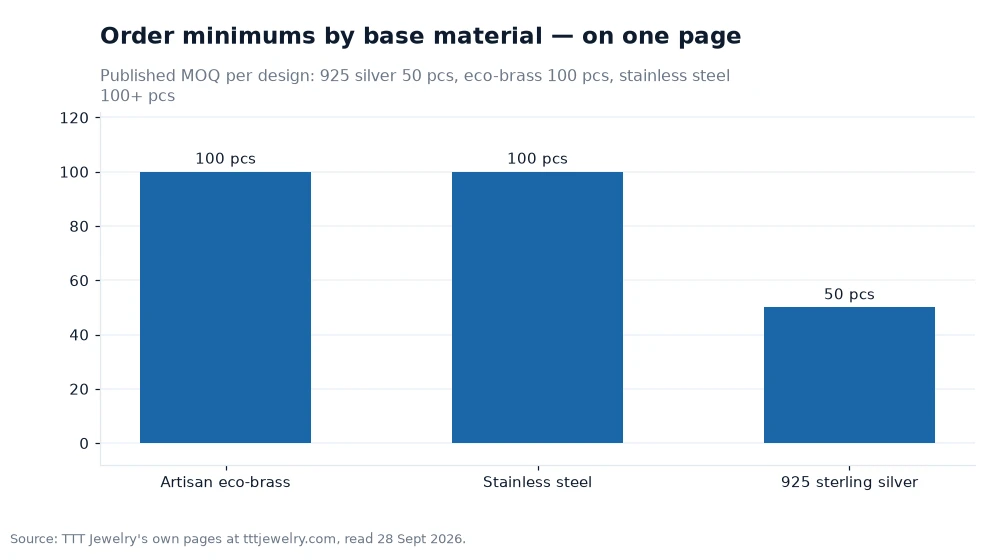
The minimum comparison explains why stainless buyers plan packaging early. At 100+ pieces per design, the steel floor is at least double the 50-piece silver minimum. Doubling the piece count doubles the pouches and labels too, so the packaging budget scales with the MOQ rather than staying fixed.
Frequently asked questions
Can a logo be engraved after the pieces are plated?
It can, but the cut then passes through the coating and the exposed edge may lift. Engraving before plating, or marking a recessed area, avoids that risk.
What is the stainless steel order minimum?
100+ pieces per design is the published stainless minimum. The brass line starts at 100 pieces per design and sterling silver at 50.
How long does a marked and packed sample take?
Allow 25–30 days for the master sample, then 3–4 weeks for bulk production, with CAD under 48 hours ahead of both.
Setting the pack before the metal is cut
The order of work is counter-intuitive: packaging should be decided before the jewelry, because the pack determines how the piece is handled, labelled and presented. A pouch size chosen after production can be wrong for the widest design. A barcode list assembled after packing can mislabel the whole run.
Brands comparing metals often discover that the pack-out is the only part of the programme that transfers unchanged between lines. The custom brass jewelry route uses the same five packaging elements, so one pack specification can serve both a steel and a brass collection if the sizes are checked against the larger piece.
Engraving and packaging are the two points where a buyer's brand meets the factory's process. Treat them as production decisions with files, dies and counts attached, and the last week of an order stops being a negotiation.
Source note: figures come from the manufacturer's own website (tttjewelry.com), read 28 Sept 2026.[1]